2 Cauchy’s integral formula
This is a generalization of the result in Key Point 2:
Key Point 3
Cauchy’s Integral Formula
If is analytic inside and on the boundary of a simply-connected region then for any point inside ,
Example 13
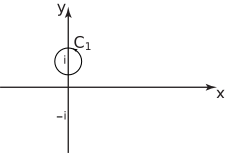
Evaluate where is the path shown in Figure 15:
Figure 15
Solution
We note that
Let .
The numerator is analytic inside and on the path so putting in the Cauchy integral formula (Key Point 3)
.
Task!
Evaluate where is the path (refer to the diagram)
-
.
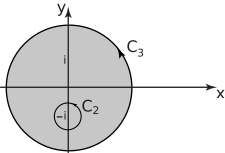
-
Use the Cauchy integral formula to find an expression for
:
. The numerator is analytic inside and on the path so putting in the Cauchy integral formula gives
.
-
Now find
:
By analogy with the previous part,
2.1 The derivative of an analytic function
If is analytic in a simply-connected region then at any interior point of the region, say, the derivatives of of any order exist and are themselves analytic (which illustrates what a powerful property analyticity is!). The derivatives at the point are given by Cauchy’s integral formula for derivatives:
where is any simple closed curve, in the region, which encloses .
Note the case :
Example 14
Evaluate the contour integral
where is a contour which encloses the point .
Solution
Since has a pole of order 2 at then
where is a circle centered at .
If then
Since is analytic within and on the circle we use Cauchy’s integral formula for derivatives to show that
.
Exercise
Evaluate where is the path:
-
We will use the fact that
The numerator is analytic inside and on the path so putting in Cauchy’s integral formula
-
Here
The numerator is analytic inside and on the path so putting in Cauchy’s integral formula:
- The integral is the sum of the two previous integrals and has value .